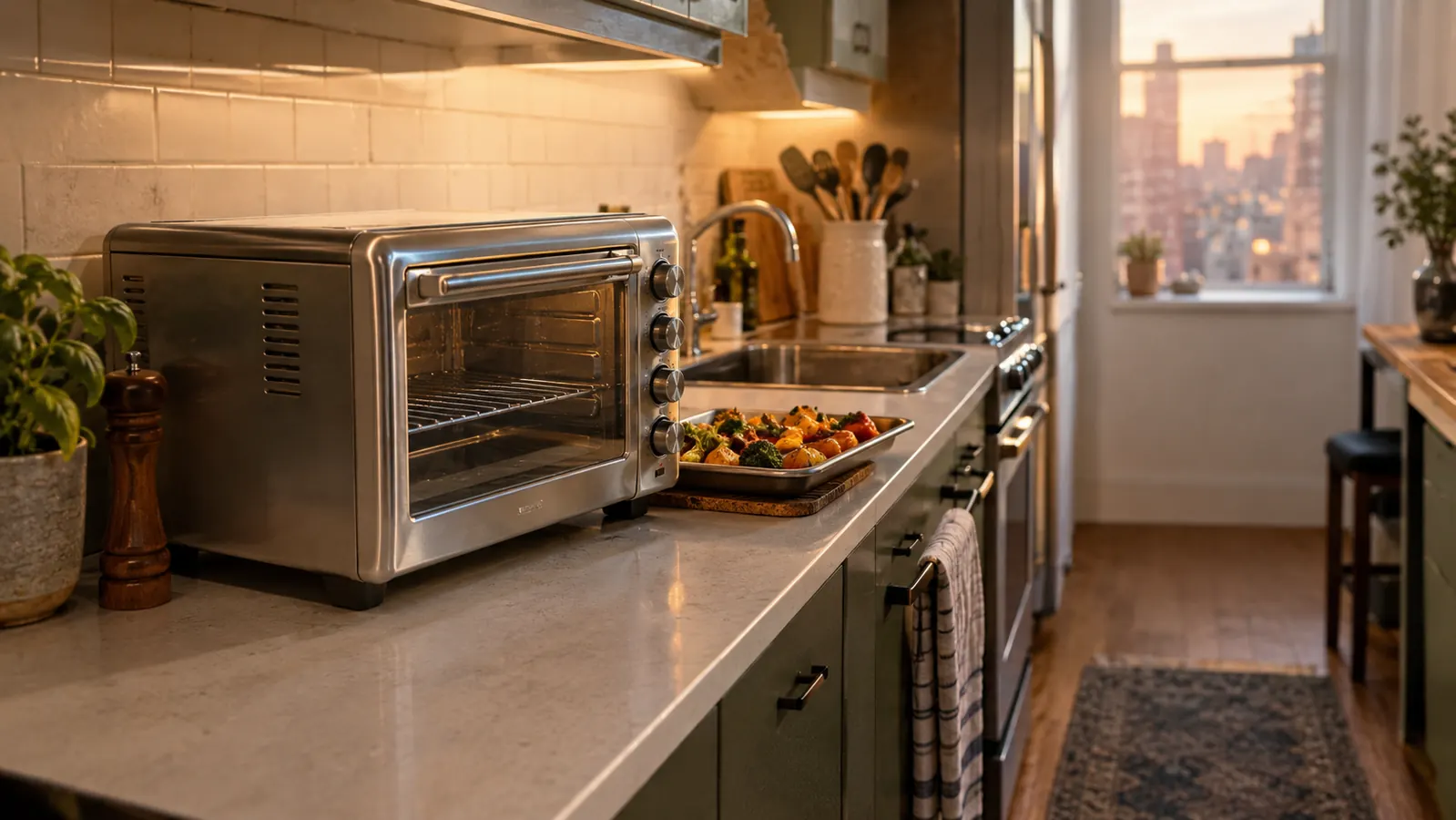
Most reviews of the BLACK+DECKER 4-slice toaster oven tell you the same three things: it is small, it is affordable, and it toasts bread. All true. What they do not tell you is what it is like to use one every day as your main oven in a small kitchen, which is exactly how I have used mine. I live alone in a one-bedroom apartment in Columbus with a galley kitchen and about four feet of counter. I have a full-size oven, but in the summer I almost never turn it on, so this little BLACK+DECKER does most of my baking, broiling and reheating. Here is the honest version, the good and the parts nobody mentions.
A little about me so you can weigh my opinions. I managed a school cafeteria for thirty years. I have run convection ovens that hold twelve sheet pans, and I have also watched cheap equipment fail in every way equipment can fail. I bought this toaster oven expecting it to be fine for toast. It turned out to be far more useful than that, with a few quirks you should know before you buy.
The Quick Verdict
The BLACK+DECKER toaster oven is a genuinely useful second oven for a small kitchen. It toasts evenly, bakes small batches well, and keeps the apartment cool in summer. The outside gets hot, the timer has to be set for anything to happen, and the broiler is close to the food, so it rewards a little learning. For one or two people, it has earned its counter space.
Amazon Check Today's Price →The small oven that does most of my cooking from May to September
If you want to bake, broil and toast for one or two without heating up the whole apartment, this is the countertop oven I use every day.
Amazon Check Today's Price on Amazon →What It Does Well
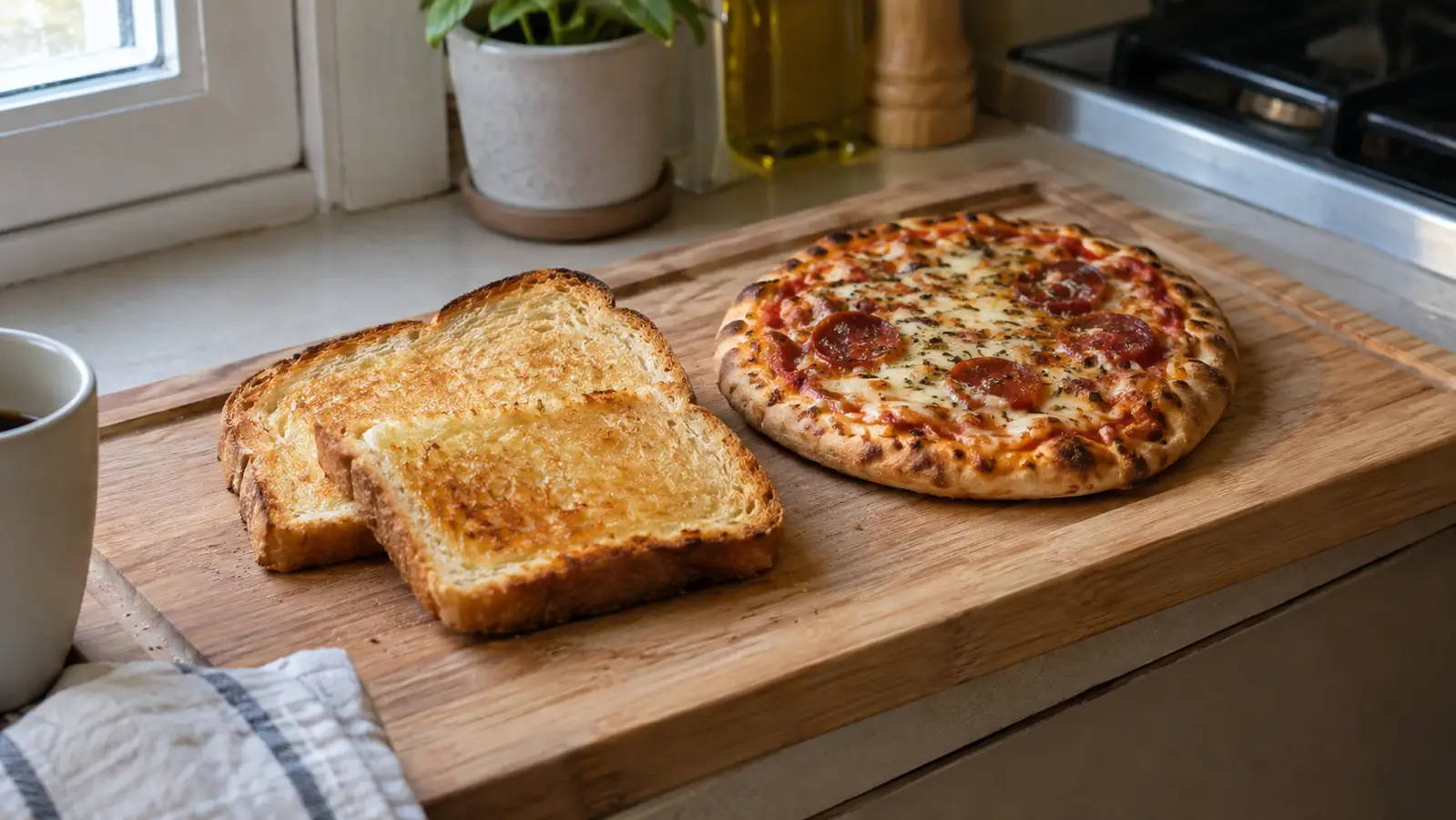
It toasts evenly, which sounds like the least you could ask and is not a given in this price range. Four slices of sandwich bread come out the same shade edge to edge, and a single slice in the middle comes out the same as four. I set the toast shade dial a little past the middle for my taste and leave it there. English muffins, bagel halves and frozen waffles all come out right on the same setting.
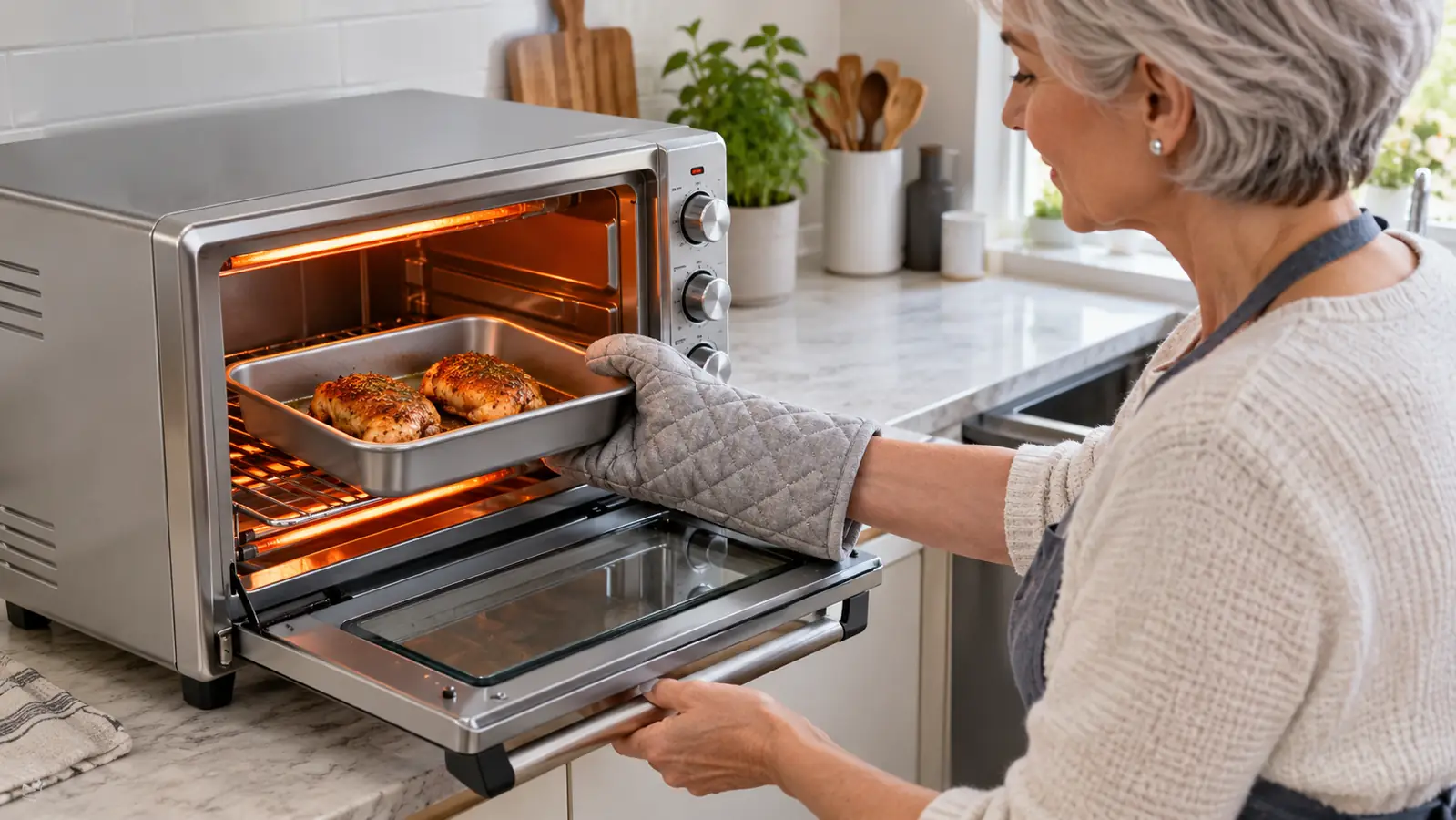
It bakes small batches better than I expected. Six cookies on the included pan, a small pan of cornbread, a single sweet potato, two chicken thighs, a few slices of meatloaf: all of these have come out well. The interior fits a 9-inch pizza, and I use that as my guide for what pans I buy. I picked up a quarter sheet pan that fits with a little room around it, and that one pan covers most of what I make.
It keeps the kitchen cool, and in a small apartment that is no small thing. Running my full-size oven for an hour in July turns the whole place into a sauna and sets the air conditioner chugging. This little oven heats a much smaller box, so the room barely notices. From late spring to early fall, the BLACK+DECKER is my oven, and the big one is a storage cabinet for sheet pans.
It is simple. There are three dials: temperature, function, and timer. Bake, broil, toast and keep warm are the functions. There is no screen to learn, no app, and no menu to scroll. I have used this kind of control on cafeteria equipment for decades, and I trust a knob more than a touch panel. If you want convection or air frying, look elsewhere. If you want something that just works, this is it.
The included pan is small and thin, and that matters more than it sounds. It works for toast, a few cookies and reheating, but it warps slightly at high heat and food sticks to it unless you line it. The single best thing I did for this oven was buy one heavier quarter sheet pan and one small square cake pan, both measured to fit with an inch of air around them. Air needs room to move around the pan for even baking, so a pan that fills the whole rack edge to edge cooks unevenly no matter what the dial says.
Preheating takes about five minutes, and you should do it. The manual is honest about this and most people skip it anyway. When I put cookies into a cold toaster oven, the bottoms burned before the tops set, because the elements were blasting at full power trying to reach temperature. When I let it preheat for five minutes first, the same cookies baked evenly. There is no preheat light on this model, so I set a kitchen timer and wait.
Rack position changes everything. There are only a couple of positions, and the difference between them is only an inch or two, but with the elements this close that inch is the difference between a golden top and a burnt one. For toast I use the middle. For baking I use the lower position so the top element is farther from the food. For broiling something thin, like garlic bread, I move it up. I wrote the positions on a little card inside the cabinet door until they became habit.
What Nobody Tells You
The outside gets hot. Not dangerously so if you treat it like an oven, but the top and sides are warm enough after twenty minutes at 400 degrees that you should not touch them, and you should not set anything on top. I keep at least several inches of clear space on every side, I do not run it under my upper cabinets when it is on high heat for a long time, and I never stack the bread bag or a dish towel on it. That is good practice for any countertop oven, and this one is no exception.
The timer is not optional. On this model the timer dial is what turns the oven on for bake and broil. If you set the temperature and function but forget the timer, nothing happens, and the first time I made that mistake I stood there for five minutes wondering why my potato was still cold. There is also a stay-on setting for long cooks. Once you know this, it becomes a safety feature I like, because the oven shuts itself off at the end of the time I set.
The broiler is close to the food. The top element sits only a few inches above the rack, which means broiling is fast and you have to watch it. A cheese toast goes from bubbly to scorched in less than a minute. I broil on the lower rack position for anything thicker than a slice of bread and I stand right there with the door window in view. Treat broil as a finishing step, not something you walk away from.
Temperatures run a little hot on mine. I put an inexpensive oven thermometer inside and found it ran about fifteen to twenty-five degrees over the dial at 350. Toaster ovens often do, because the elements are close to the food. I now set it a notch lower than a recipe says and check things a few minutes early. If you bake anything fussy, like a small cake, a thermometer is worth having.
The crumb tray is your friend, and you will forget about it. It slides out from the front, and if you do not empty it every week or so the crumbs will start to smoke on the next high-heat bake. I empty mine every Sunday after the grandkids have had their toast, and I wipe it with warm soapy water once a month. That one habit has kept the kitchen from smelling like burnt toast.
Cooking Every Day With It
A typical weekday looks like this for me. Toast in the morning. At supper, a piece of fish or two chicken thighs on the small pan at 375 for about twenty-five minutes, with a few sliced vegetables tossed in oil on the same pan. Leftovers reheated on the rack the next day instead of in the microwave, because pizza and roasted vegetables come back crisp instead of soggy. One small pan, one oven, one counter.
On Sundays the grandkids get personal pizzas. I buy small premade crusts, they choose their toppings, and the pizzas go in one at a time at 400 for about ten minutes. They love watching through the window, and I love that I am not heating a full-size oven for two six-inch pizzas. The 9-inch interior is perfect for this, and I can get the second pizza in while the first one is cooling.
Baking for one is where it surprised me most. A full batch of cookie dough becomes a few cookies at a time on the small pan, and the rest goes in the freezer in balls. When I want something sweet, I bake three cookies in twelve minutes. Muffins work in a six-cup tin I bought to fit. A small fruit crumble in a loaf pan has become a regular dessert. None of that happened when the only option was turning on the big oven.
Reheating is the quiet reason I would buy it again. A slice of leftover pizza at 350 on the rack for six or seven minutes comes back with a crisp bottom and melted cheese, nothing like the rubbery result from a microwave. Roasted vegetables, a piece of leftover salmon, a day-old biscuit and a half a casserole in a small dish all come back the way they were the first night. For someone who cooks once and eats twice, that adds real value to every meal.
Energy and noise are both low. It makes a quiet ticking from the timer and a faint hum, and that is all. I can run it while I am on the phone in the next room and hear the ding when it finishes. I have not measured my electric bill to the penny, but heating a small box for twenty minutes clearly uses less than heating a full oven for forty, and my summer bills have been lower since I moved the cooking over to it.
The Jobs I Gave Back to the Big Oven
It is honest to say what it cannot do. A whole chicken does not fit. A 9 by 13 casserole does not fit. A Thanksgiving anything does not fit. Two loaves of bread do not fit. When I host my family, the full-size oven comes back into service, and the BLACK+DECKER handles the rolls and the side dish on the counter.
It also is not an air fryer. It has no fan, so frozen fries and wings come out good but not shatteringly crisp. If crisp frozen foods are what you eat most, an air fryer is the better tool, and I compared the two directly in my toaster oven versus air fryer comparison. For baking, broiling and toast, the toaster oven wins in my kitchen.
Cleaning and Care
Cleaning is manageable if you keep up with it. The rack and baking pan go in the sink. I line the pan with foil for anything greasy, which saves a lot of scrubbing, but I never let foil touch the heating elements or cover the crumb tray, because that can cause overheating. The glass door wipes with a damp cloth once it is cool. The inside walls are not nonstick, so I wipe splatters after each greasy cook while they are still soft rather than letting them bake on.
After months of daily use, the heating elements still glow evenly, the dials still click firmly, and the door hinge feels as solid as it did the first week. The outside has a few small marks near the door handle from oven mitts, which is cosmetic. It has been more durable than I expected for something this light.
Small Kitchen Fit
It is about fifteen and a half inches wide and fits on a counter that is a standard depth with room behind it for air to move. It is light enough to slide forward with one hand when I need to clean behind it. I keep it on the end of the counter by the stove, away from the sink and away from the wall cabinets, plugged directly into a wall outlet. Like every appliance that heats, it does not go on a power strip in my kitchen.
What I Liked
- Even toasting edge to edge, one slice or four
- Bakes small batches well and fits a 9-inch pizza
- Keeps a small apartment cool compared to a full oven
- Simple three-dial controls with an automatic shutoff timer
- Light and compact enough for a galley counter
Where It Falls Short
- Exterior gets hot, so it needs clearance on all sides
- Timer must be set or the oven will not run
- Broiler sits close to the food and needs watching
- Runs a little hot, so a thermometer helps
- No fan, so frozen foods are not as crisp as an air fryer
From late spring to early fall, the BLACK+DECKER is my oven, and the big one is a storage cabinet for sheet pans.
Who Should Buy It
If you live alone or with one other person and want a second oven that saves energy, keeps the kitchen cool and handles toast, small bakes and broiling, the BLACK+DECKER 4-slice toaster oven is an easy recommendation. It is especially good for apartments, condos, dorms and anyone who has downsized. For a deeper look at months of daily cooking, read my long-term review, and for the bigger picture see ten reasons a compact toaster oven can replace your big oven.
If you cook for a family most nights, need convection, or mostly eat crispy frozen foods, buy something larger or an air fryer instead.
A second oven that fits on four feet of counter
The BLACK+DECKER 4-slice toaster oven toasts, bakes and broils for one or two, and it keeps a small kitchen cool while it does it.
Amazon Check Today's Price on Amazon →