
When I moved out of the family house into a one-bedroom apartment in Columbus three years ago, I gave away most of my appliances. The full-size food processor went first. It had a 14-cup bowl, a feed tube, and three attachments, and its storage problem was the reason I stopped using it long before the move. My galley kitchen has about four feet of usable counter and one small two-door pantry cabinet, so every machine now has to earn its spot or it goes in the closet. I kept a chef's knife and told myself that was enough. For about a year I chopped everything by hand and pretended I did not miss the machine. Then a Sunday afternoon of making coleslaw for the grandkids left my right hand aching, and I started looking for something small enough to live on the counter.
The Hamilton Beach 3-Cup Electric Vegetable Chopper and Mini Food Processor ended that search. It has sat on my counter for about seven months now, between the toaster and the outlet strip, and that is the highest compliment I can give an appliance in this apartment. This is a long-term review from someone who actually cooks every night: what it handles well, what it does not, and whether it is worth the space.
The Quick Verdict
A genuinely useful little chopper that earns its counter space in a small kitchen, as long as you understand it chops and minces instead of slicing and shredding. Easy to clean, easy to store, and it gets used every week.
Amazon Check Today's Price →The 3-cup chopper that earns its spot on a four-foot counter
If you are tired of chopping onions by hand in a tiny kitchen, this is the small appliance I reach for most weeks. It minces, chops, and purees in seconds, and the bowl, lid, and blade all go in the dishwasher.
Amazon Check Today's Price on Amazon →How I've Used It
I have owned this chopper for about seven months, and it has never once been put away in the pantry. It lives on the counter between the toaster and the outlet strip, which is prime real estate in a kitchen with four feet of work space. Most weeks I use it three or four times. Sunday is the big day, because that is when the grandkids come over and I cook a real meal instead of my usual quick dinner for one. It has become the first thing I reach for when a recipe starts with the words finely chop.
The jobs I lean on it for: a small onion for meatloaf, celery and carrot for soup, garlic and herbs for a quick pasta sauce, and the coleslaw that started this whole search. I also use it for things I never bothered with using my old machine, because the old machine was too big for small jobs. Chopping one shallot for a pan sauce used to mean hauling out a 14-cup bowl, washing the lid, and finding a place for everything while I cooked. Now I drop the shallot in, pulse four or five times, and scrape it into the skillet. The machine does not even leave the counter.
One thing that surprised me is how well it handles wet and dry jobs without any change of parts. The same blade that minced garlic on Tuesday crumbed saltines on Friday. I have made hummus in it, crumbed crackers for a casserole topping, and chopped walnuts for a Sunday morning coffee cake. It will not grind a pound of meat, and I do not ask it to. For the jobs that fit the bowl, it does them in seconds, and the cleanup is the same either way.
What It Chops Well (and What It Won't)
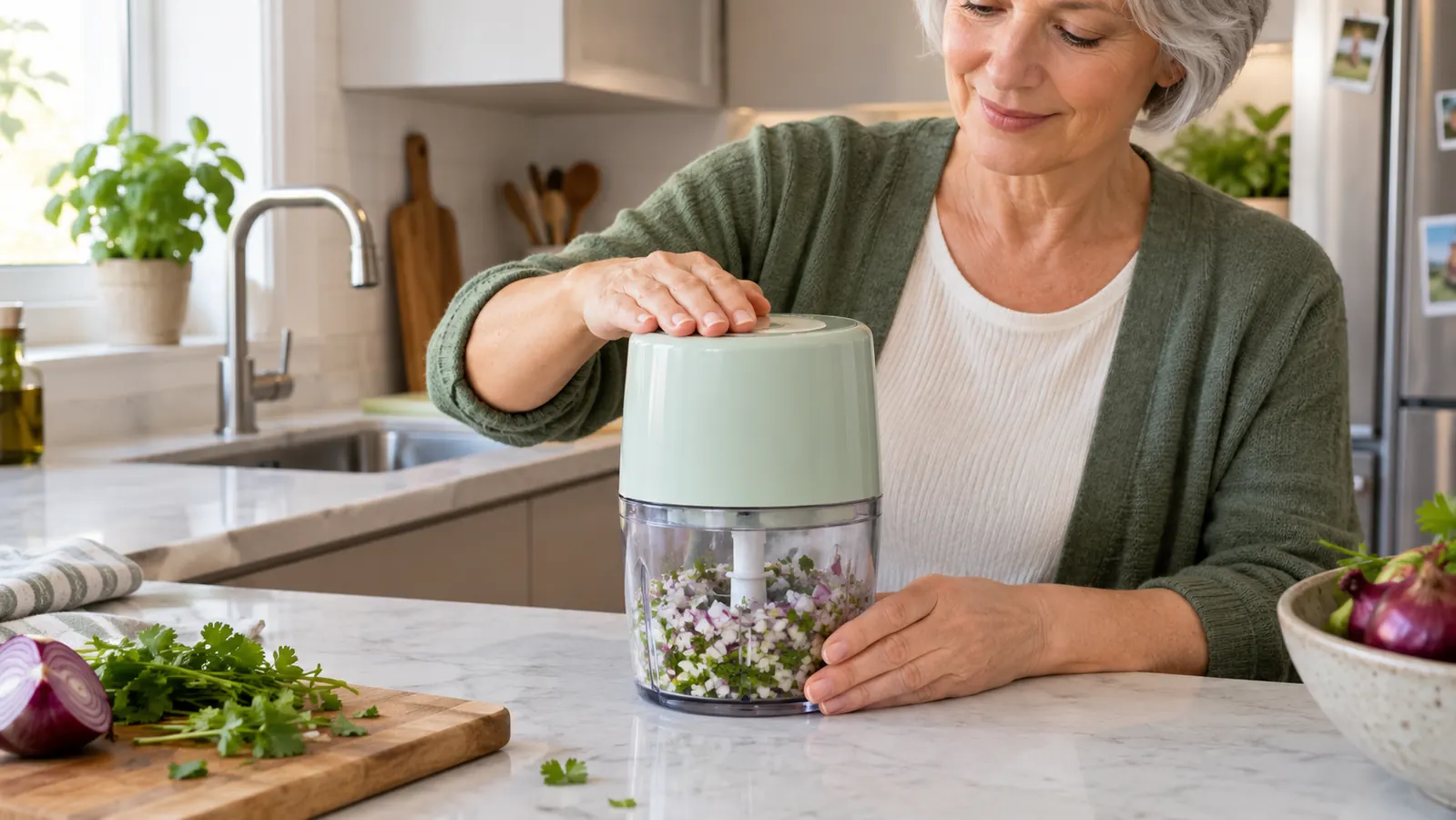
The 3-cup bowl sounds small until you actually use it. A whole medium onion fits if you cut it into quarters first, and two celery ribs, one carrot, and half an onion, all chunked, fill it just about right for a soup base. I have learned to work in small batches, and that is the tradeoff for a machine that takes up a quarter of the counter space my old processor did. When I first got it, I tried to cram a whole onion in without quartering it, and it came out uneven. Once I started cutting things into rough chunks first, every batch came out consistent.
Soft and medium-firm foods are where it shines. Onions, celery, carrots, bell peppers, mushrooms, garlic, fresh herbs, boiled eggs, cooked chicken, and cheddar all come out evenly minced in a few pulses. Last month I made a pimento cheese spread for a church potluck, and the whole batch came together in the bowl without me moving anything. A block of cheddar cut into one-inch cubes, a jar of pimentos, and a spoonful of mayo, pulsed about twelve times, and it was done. Nobody at the potluck guessed it took less than five minutes.
What it will not do is slice. There is no disk, no shredding attachment, no julienne blade. If you want perfect rounds of cucumber or grated zucchini for a casserole, this is not the machine. I tried to slice mushrooms with it once, out of hope more than sense, and what came out was chopped mushrooms. They were fine for the gravy, but not what I had pictured. It chops, minces, and purees, and I have stopped expecting it to be anything else. That honesty about its limits is part of why I still reach for it. I know exactly what I am getting, so I never feel let down.
Cleaning Is the Reason It Stays on the Counter
Every appliance I have ever stopped using died the same death: it was a pain to clean. My old processor had a lid with three interlocking pieces, a feed tube, and a bowl with ridges that trapped food. I would use it, wash it, put it away, and feel like I had done two jobs instead of one. The electric griddle I gave away when I downsized was worse, because the grease trap alone took longer to scrub than the pancakes took to cook.
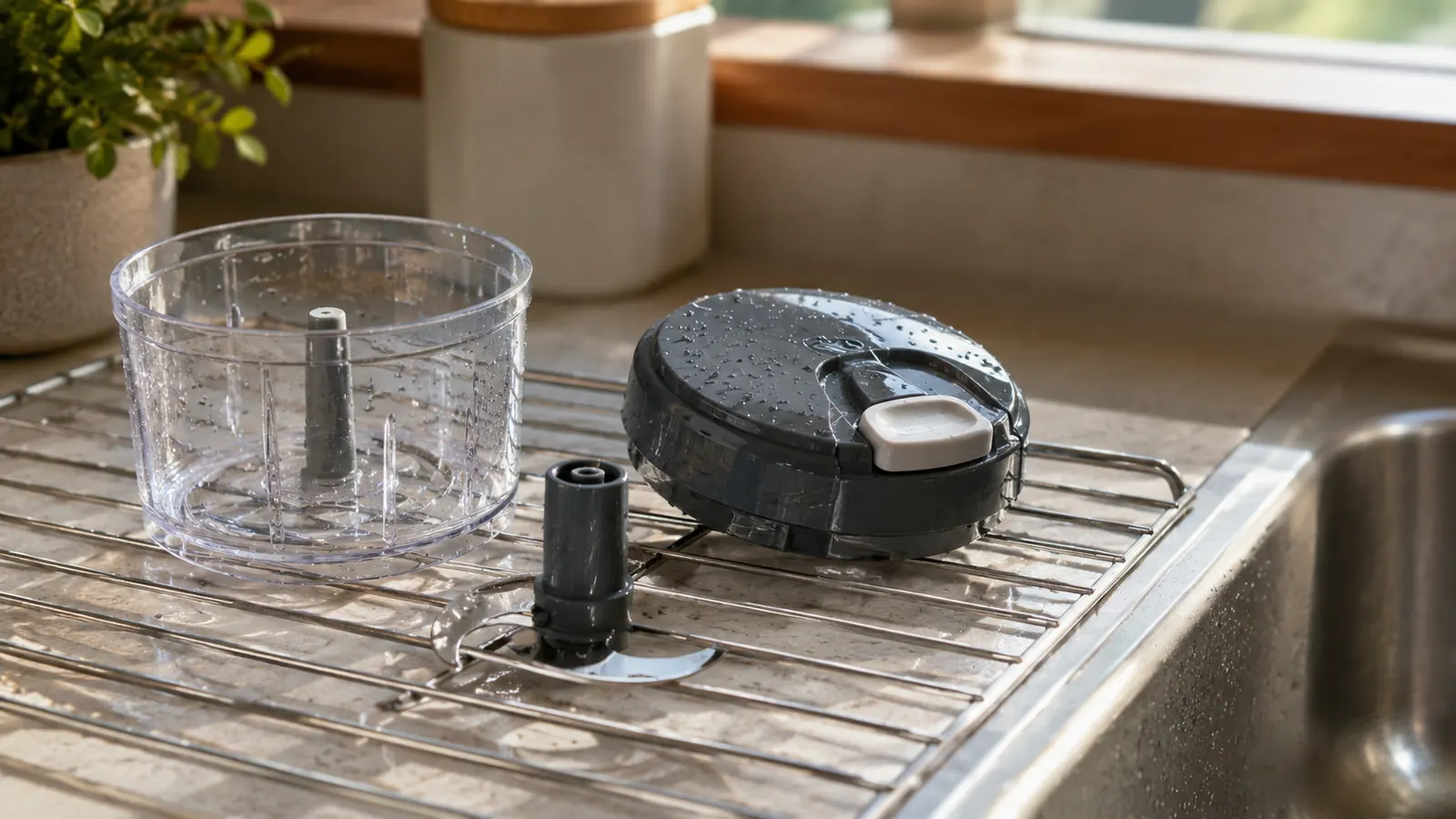
The Hamilton Beach chopper is the opposite. The bowl, lid, and chopping blade come apart in about ten seconds. The blade sits in the bottom of the bowl and lifts out with a small tab, so you never have to reach into a pile of chopped onion to find it. Everything except the base goes in the dishwasher. Most nights I just rinse the bowl and blade under hot water and set them on the drying rack while dinner cooks. From dirty to clean takes about two minutes, and that is the reason this machine has never been relegated to the pantry.
This matters more than any feature on the spec sheet. A machine you can clean without thinking is a machine you will use. I have owned this chopper for seven months, and it has never once been put away in the closet. I cannot say that about the three slow cookers, the electric griddle, or the full-size processor I gave away when I moved. They were all useful. They were all a chore to clean. This one is not.
How It Handles the Jobs I Actually Cook
Sunday dinner for the grandkids is my weekly test. A few weeks ago I made meatloaf, mashed potatoes, and green beans, and the chopper earned its keep before the oven even preheated. Half an onion and two cloves of garlic went in the bowl, pulsed about six times, and were minced while I was still getting the ground beef out of the fridge. From onion to bowl to skillet took about forty-five seconds, including the rinse. By the time I had the meatloaf shaped, the chopper was already clean and back on the counter.
Another Sunday I made chicken salad for sandwiches. One celery rib, a quarter of an onion, and about a cup of cooked chicken went in the bowl in two batches. A few pulses for the vegetables, then a few more with the chicken and a spoonful of mayonnaise, and it was done. The old way took me close to ten minutes and left me with a cutting board full of bits and a tired hand. I remember the exact Sunday I switched over, because it was the first time I made chicken salad without dreading the chopping.
The job I keep coming back to is the coleslaw. A quarter of a small cabbage, chunked, with one peeled carrot, pulses down to the right texture for creamy slaw in about eight seconds. I do not even pull out the big bowl anymore. If I had owned this chopper three years ago, my hand would never have started complaining in the first place. That is the real test of a small appliance: not whether it works, but whether it changes the way you cook. This one did.
The Downsides Worth Knowing
No small appliance is perfect, and this one has three honest drawbacks. First, the 3-cup bowl really is small. Anything bigger than one recipe's worth of vegetables has to be done in batches, and I have learned to accept that. Second, the switch is a press-and-hold, not a pulse button. You control the texture with your thumb, and it took me a couple of weeks to get the rhythm. I over-chopped a batch of onions into almost a paste before I figured out that two short presses beat one long one.
Third, the base is light, so it can wander on the counter if you push down hard. I hold the base with one hand and the lid with the other, and that completely solves it. None of these are dealbreakers. They are the difference between reading a spec sheet and actually living with a machine. There is also the cord, which is short, maybe two feet. In my kitchen the outlet strip sits under the cabinet and the cord reaches the counter fine, but it is worth measuring your own setup before you decide where the chopper will live.
Before I bought this chopper, I tried a hand-powered mini chopper, the kind you press down on like a pump. It worked for about two weeks and then the spring gave out, and my hand hurt worse than if I had used a knife. I also tried just getting better at knife work, watching videos and practicing my grip. That helped some, but nothing fixes the fact that a small electric machine does in eight seconds what takes me eight minutes. I mention all this because the Hamilton Beach chopper is not the only small chopper on the market, but it is the one that has lasted.
What I Liked
- Small enough to live on the counter instead of in a closet
- Chops onions, celery, carrots, herbs, cheese, and cooked chicken in seconds
- Bowl, lid, and blade come apart and go in the dishwasher
- Press-and-hold switch means you decide the texture
- Three-cup size is right for one or two people
Where It Falls Short
- Bowl is genuinely small; bigger jobs need batches
- No slicing or shredding disks
- Press-and-hold switch takes a couple of weeks to learn
- Light base can shift if you push down hard
From dirty to clean takes about two minutes, and that is the reason this chopper has stayed on my counter for seven months.
Who This Is For
Buy this if you cook for one or two people, live in a small kitchen, or find yourself chopping an onion by hand and wishing you had a machine that did not take over the counter. It is also a good fit if you are downsizing, like I did, and you need one small machine to cover the jobs your full-size processor used to do. And if you are tired of washing a 14-cup bowl for a single shallot, this is the answer to that specific annoyance. It does not replace a full-size processor, and it is not trying to.
Who Should Skip It
Skip it if you cook for a crowd every week, if you need slices instead of chops, or if you expect it to behave like a full-size food processor. It cannot knead dough, slice a cucumber into rounds, or shred a pound of cheese in one go. If most of your chopping is for four or more people, the batches will frustrate you. And if you already own a full-size processor that you actually use, you do not need this one. Buy it for the small jobs, the nightly jobs, the jobs you currently do with a knife because no machine seemed worth the trouble.
The small-kitchen chopper that has stayed on my counter for seven months
If you want one small machine that handles the daily chopping without taking over your kitchen, this Hamilton Beach chopper is worth a look. It chops, minces, and purees, it cleans up in two minutes, and it earns its spot.
Amazon Check Today's Price on Amazon →