
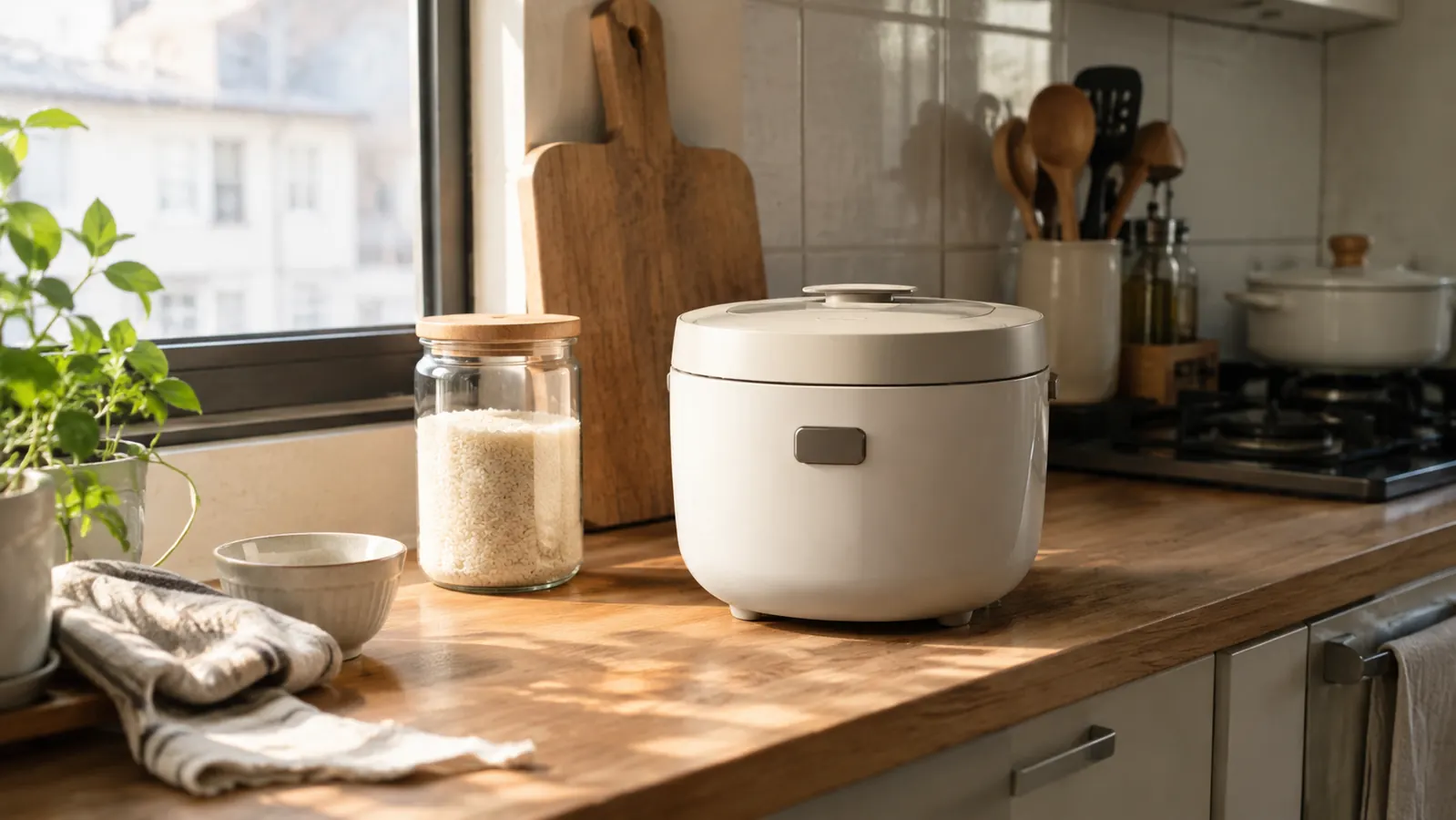
Every appliance I own has to survive the same test now. I downsized three years ago from a house with a full kitchen to a one-bedroom apartment in Columbus, and my galley counter measures about four feet. If something sits there for a month without being used, it goes in the pantry closet, and if it sits in the closet for another month, it goes to the donation bin. That is the standard the Aroma 3-Cup Rice Cooker had to meet when I bought it right after I moved in, and it is still on the counter today. That alone tells you most of what you need to know.
But this is the honest review, so here is the rest of what you need to know. The rice it makes is genuinely good, week after week, with no watching and no stirring. The things nobody puts in the product photos are also real: the measuring cup that does not match your measuring cups, the keep-warm setting that dries rice out if you trust it too long, and the cleaning routine that takes more patience than the cooking does. I have used this cooker four or five times a week since October, including Sunday dinners for my two grandkids, and I would buy it again. I would just buy it knowing a few things first.
The Quick Verdict
A genuinely good small rice cooker that earns its counter space, with a few quirks you should know about before you buy. The rice is consistent, the footprint is tiny, and every limitation here is manageable once you know it exists.
Amazon Check Today's Price →The little cooker that has earned its spot on my four-foot counter
If you cook for one or two and your counter is as short as mine, this is the rice cooker I keep reaching for. Check the current price on Amazon and decide for yourself.
Amazon Check Today's Price on Amazon →How I've Used It
I am a retired school cafeteria manager, so I have strong opinions about feeding people efficiently. For the first month I treated the Aroma like a test subject. I made white rice, brown rice, long-grain and jasmine. I made oatmeal on a Tuesday morning when I was in a hurry. I made a small pot of soup on a cold evening, and I made a full batch of rice for the Sunday afternoon visits from my grandkids, who will eat rice by the bowlful if I let them.
My standard week looks like this: one cup of uncooked rice on Monday, which gives me about three servings. I eat one that night with whatever I have going, I refrigerate one portion for Wednesday, and I freeze the third for a busy night. On Sunday I fill the pot to the three-cup line and cook the whole thing for the three of us. The cooker is small enough to live on the counter next to the outlet strip, and light enough that I can move it to the pantry shelf when I need the space for something bigger.
The controls could not be simpler. There is a cook switch that clicks down when you start, a warm light that comes on when it finishes, and that is the whole interface. My older grandson can run it, which is not something I can say for most of my appliances. That simplicity is the reason it has stayed out of the donation bin.
The Sunday batch is the one that matters most to me. My grandkids come over after church, and by the time they arrive I want rice that is done and holding, not a pot I have to babysit. I put in the full three cups, click the switch, and set the table. Twenty-five minutes later I fluff it, and we eat. It has never once been undercooked or scorched on a Sunday, and that reliability is the reason I have not felt the urge to replace it with anything fancier.
What Nobody Tells You About the Measuring Cup
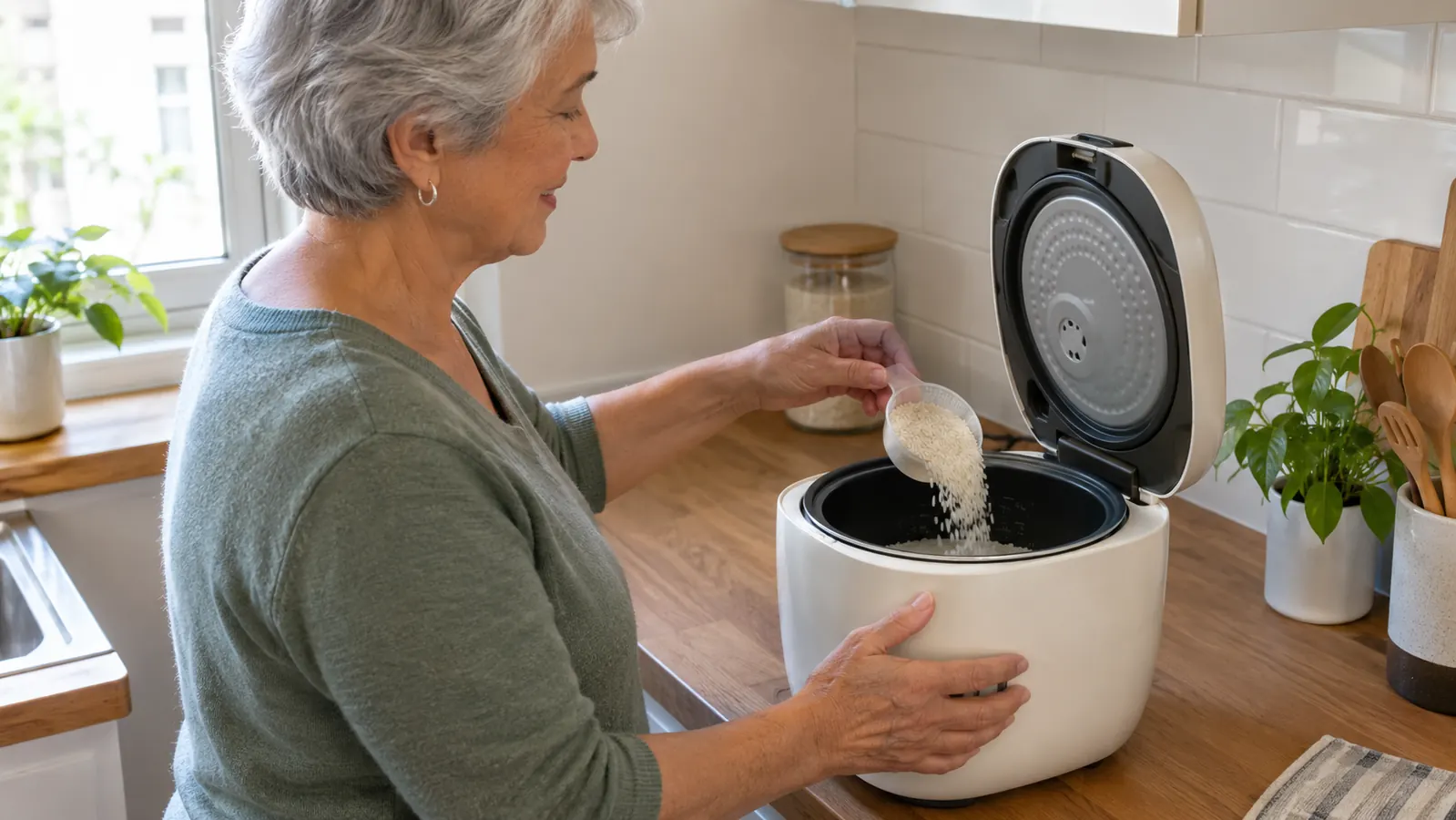
Here is the thing nobody mentions in the reviews. The little cup that comes in the box is not a standard measuring cup. It is a rice cup, about 180 milliliters, which is roughly three-quarters of a regular cup. For the first two weeks I ignored it and used my own measuring cup, and the rice came out gummy and heavy every time. I was putting too much rice in relation to the water line inside the pot.
The water line inside the inner pot is calibrated to the little cup, not to your measuring cups. One cup of rice means one level scoop from the included cup, then water up to the line marked one. Two cups of rice, water to the line marked two. Once I stopped being stubborn and used the included cup, the gummy rice problem vanished. It sounds like a small thing, but it is the difference between an appliance that makes you feel foolish and one that makes you look competent.
The other thing about the lines: they are molded into the inner pot, and they are genuinely easy to read even for eyes that need reading glasses. I do not have to squint or hold the pot up to the light. I fill the rice, add water to the line, click the switch, and walk away. That sounds like a low bar, but I have owned cookers where the markings wore off within months. These are still clear after years of near-daily use and hand washing.
The Keep-Warm Setting Is Not a Crock Pot
The auto keep-warm is the feature that sold me, and it is also the feature that taught me the most about this cooker's limits. When the rice finishes, the switch pops up and the cooker holds the pot at a gentle temperature. For about thirty minutes, the rice is perfect. For the first hour, it is still very good. After that, the rice at the bottom starts to dry and firm up, and if you leave it for a few hours you get a crust that has to be soaked off.
The fix is simple and it has become my habit. I start the rice about forty minutes before I actually want to eat, and I fluff it and serve it within the first half hour of it finishing. If I am making rice ahead of time for the week, I turn the cooker off and refrigerate the rice in a covered container instead of trusting the warm setting. Rice reheats beautifully with a damp paper towel over the bowl, so the keep-warm is a convenience, not a storage solution.
I tested the keep-warm once, the way I test everything, by leaving a batch on warm while I went to visit a neighbor. When I came back two hours later, the top rice was fine and the bottom layer had turned into something closer to a rice cake. That is not a defect. It is the nature of a small pot with a heating element directly underneath. But nobody tells you that in the listing, and it is worth knowing before you set it and forget it.
Cleaning: The Part the Product Photos Skip
Cooking with this rice cooker takes two minutes of active work. Cleaning it takes about five, and the five are not my favorite five of the day. The inner pot has a nonstick coating, which means rice releases easily but also means you cannot use a metal spoon or an abrasive scrubber on it. I use a soft sponge and warm soapy water, and the pot rinses clean in under a minute most nights.
The lid is the part that takes patience. Steam condenses on the underside while the rice cooks, and that thin film of cooked-on starch needs a wipe after every use. If I skip it, it dries into a cloudy residue that takes real scrubbing to shift. I have also learned to keep the little steam vent clear. A grain of rice lodged in there once made the lid rattle and spit water onto the counter, and it took me a minute to figure out what was happening.
The cord is short, which is a blessing in a kitchen with one outlet strip and a curse if your outlet is far from where you want to cook. Mine sits close to the strip, so it works. The whole cooker is light enough to lift with one hand and small enough to stand in the back of my pantry cabinet. When I need the counter for a big mixing job, it moves in ten seconds. That ease of storing is a real part of why it has stayed in regular rotation.
It Does More Than Rice, If You Adjust Your Expectations
The listing mentions oatmeal and soup, and both work, but they work differently than you might expect. Oatmeal is the better of the two. I use the included cup to measure one part steel-cut oats to about three parts water, stir once when it comes to a boil, and let the cooker do the rest. The key is to serve it soon after it finishes, because the keep-warm will scorch the bottom if oatmeal sits on it too long.
Soup is more of a warm-through situation than a slow-simmer situation. The cooker heats gently, so it is fine for reheating broth and vegetables, but it will not brown anything and it does not boil aggressively. I use it for a quick cup of broth on a cold evening more than I use it for actual soup making. Quinoa works well with the same rice-to-water logic, one part quinoa to two parts water, and comes out fluffy every time I have tried it.
None of these extras are why I bought the cooker. They are the reason it survived the first month instead of going back in the box. An appliance that only does one job has to do that job perfectly to earn counter space. This one does rice perfectly, and the oatmeal and broth are pleasant bonuses that keep it useful on days when rice is not on the menu.
The Size Question Nobody Asks
Three cups uncooked means six cups cooked, and that sounds small until you do the math for your own life. For me, one cup of uncooked rice feeds me for three meals. The full three-cup batch feeds my two grandkids and me on Sunday with leftovers. If you are cooking for a family of four or five with serious appetites, this pot is too small and you should look at the five-cup or eight-cup versions instead.
The flip side is that the small size is exactly why it wins in my kitchen. It fits under the wall cabinet with room to spare. It does not block the outlet strip. It heats fast because there is less to heat, so a single cup of rice is done in about twenty minutes. A bigger cooker would take longer, use more counter space, and give me leftovers I do not want. The size is a feature when you cook for one, and a limitation only when you cook for more than three.
My advice is to count the people at your table, not the people in your house. If you regularly feed more than three adults, buy bigger. If you cook for yourself or yourself plus a child or two, this is the right size, and the small footprint is the whole point. A pot that is too big makes you feel guilty about running it half full, and this one is never half full in my kitchen.
What I Liked
- Consistent rice every time, with no stirring or watching
- Tiny footprint that fits a short counter and stores in seconds
- Simple one-switch controls that a child can operate
- Clear water lines inside the pot that are easy to read
- Oatmeal, quinoa, and broth all work well with minor adjustments
Where It Falls Short
- The included cup is a rice cup, not a standard measuring cup, which causes gummy rice until you learn the system
- Keep-warm dries the bottom layer after about 30 to 45 minutes
- Nonstick pot and lid need gentle handling and a quick wipe after every use
- No timer or delay start, so you cannot schedule rice for a specific time
- Short cord limits where you can place it in a small kitchen
Years of near-daily use, and the rice has come out the same every single time. That consistency is worth more to me than any feature the listing could promise.
Who This Is For
Buy this cooker if you cook for one or two people and you have a small kitchen that makes you think twice about every appliance. Buy it if you eat rice a few times a week and you want it to be good without watching a pot. Buy it if you are downsizing, like I did, and you need appliances that earn their place and can move to a shelf when they are not earning it. The Aroma is the appliance I recommend to friends who just moved into apartments, because it does one thing, does it well, and gets out of the way.
Who Should Skip It
Skip it if you regularly cook for more than three adults, because the full batch simply will not stretch that far. Skip it if you need a rice cooker that is also a pressure cooker, a steamer, and a slow cooker, because this one does gentle, simple jobs and nothing more. Skip it if you are the kind of cook who wants to set a timer in the morning and come home to rice waiting, because there is no delay start on this model. And skip it if you will not hand wash a nonstick pot, because the coating needs gentler care than a metal pot does.
None of that makes the Aroma a bad cooker. It makes it an honest one. It is a small appliance with a small appliance's limits, and the people who love it are the people who understand those limits going in. I am one of them, and I would not trade my counter space back.
If you cook for one or two, this is the rice cooker I keep reaching for
All this time later, it is still on my counter, and that is the highest compliment I can give any appliance. Check the current price on Amazon and see if it earns a spot in your kitchen too.
Amazon Check Today's Price on Amazon →