
When I moved out of the family house into a one-bedroom apartment in Columbus three years ago, I gave away more than half my kitchen. The full-size food processor went first. It had a 14-cup bowl, three blades, and a lid that took two hands and a little luck to get right, and in my new galley kitchen it would have eaten the entire counter. I told myself I would just chop by hand. And I did, for about a year, until I got tired of crying over onions on a Tuesday night. That is when I started reading about the Hamilton Beach 3-Cup Food Chopper, and I ordered one with low expectations and a plan to send it back if it did not earn its place.
This is the honest review I wish I had read before I bought it. Not the product page version, and not the five-star version. The version that tells you what it is like to live with this thing in a small kitchen, where it lets you down, and whether it still earns its spot seven months later. I am not a food blogger and I do not get paid for opinions. I am a retired cafeteria manager who cooked for hundreds of people for thirty years and now cooks for one, on about four feet of counter.
The Quick Verdict
Seven months in, this is the small appliance I reach for most. It is not perfect: the lid is fussy, the usable bowl is closer to 1.5 cups than 3, and you have to hold the top while it runs. But for real cooking in a small kitchen, it does the work of a processor that takes up four times the space.
Amazon Check Today's Price →The Chopper That Ended My Onion Tears
After seven months of daily use in a galley kitchen, this is the small appliance I reach for most. Check today's price on Amazon and see if it fits the way you cook.
Amazon Check Today's Price on Amazon →How I've Used It
I bought mine seven months ago, after a Sunday with my grandkids that ended with me chopping vegetables for an hour and a half while they watched cartoons. I used it for the first time that same evening, on an onion, and I stood there a little stunned. Forty seconds, maybe less, and the onion was finer than anything I ever managed with my chef's knife. Since then it has made salsa at least twice a month, pesto in the summer when the basil on the windowsill gets ahead of me, breadcrumbs from the heels of bread that used to go in the compost, garlic for pasta, nuts for cookies, and enough tuna salad for one person to last three lunches.
I kept a small notebook on the counter for the first month, because I did not trust my memory. I wanted to know if I would actually use it after the newness wore off, or if it would end up in the pantry cabinet with the other appliances I gave up on. The notebook says I used it eleven times in the first week, then settled into a steady three or four times a week. Some weeks it is every day. The week I made chili for a potluck, it ran four times in one afternoon, and it handled that without a single complaint.
One thing I did not expect is that it changed how I cook. When chopping is the barrier, you skip the fresh onion or reach for the jarred stuff. With this on the counter, I use real garlic, real herbs, real onions, because the work is done in under a minute. For a person cooking alone, that is the whole argument for the thing. It does not just save time. It changes what you are willing to cook on a Tuesday.
It does three jobs better than anything I have owned. Salsa is the first: two tomatoes, half an onion, a jalapeno, a handful of cilantro, four pulses, ten seconds. Breadcrumbs are the second, and they taste like a different ingredient than the ones from a can. Pesto is the third, because a 3-cup bowl is exactly the right size for one batch, and it cleans up in a minute. The pulse control is why all of it works. A quick press gives a coarse chop, a longer press gives something finer, and after a few weeks you can hit whatever texture you are after.
What Nobody Tells You About the Lid and the Button
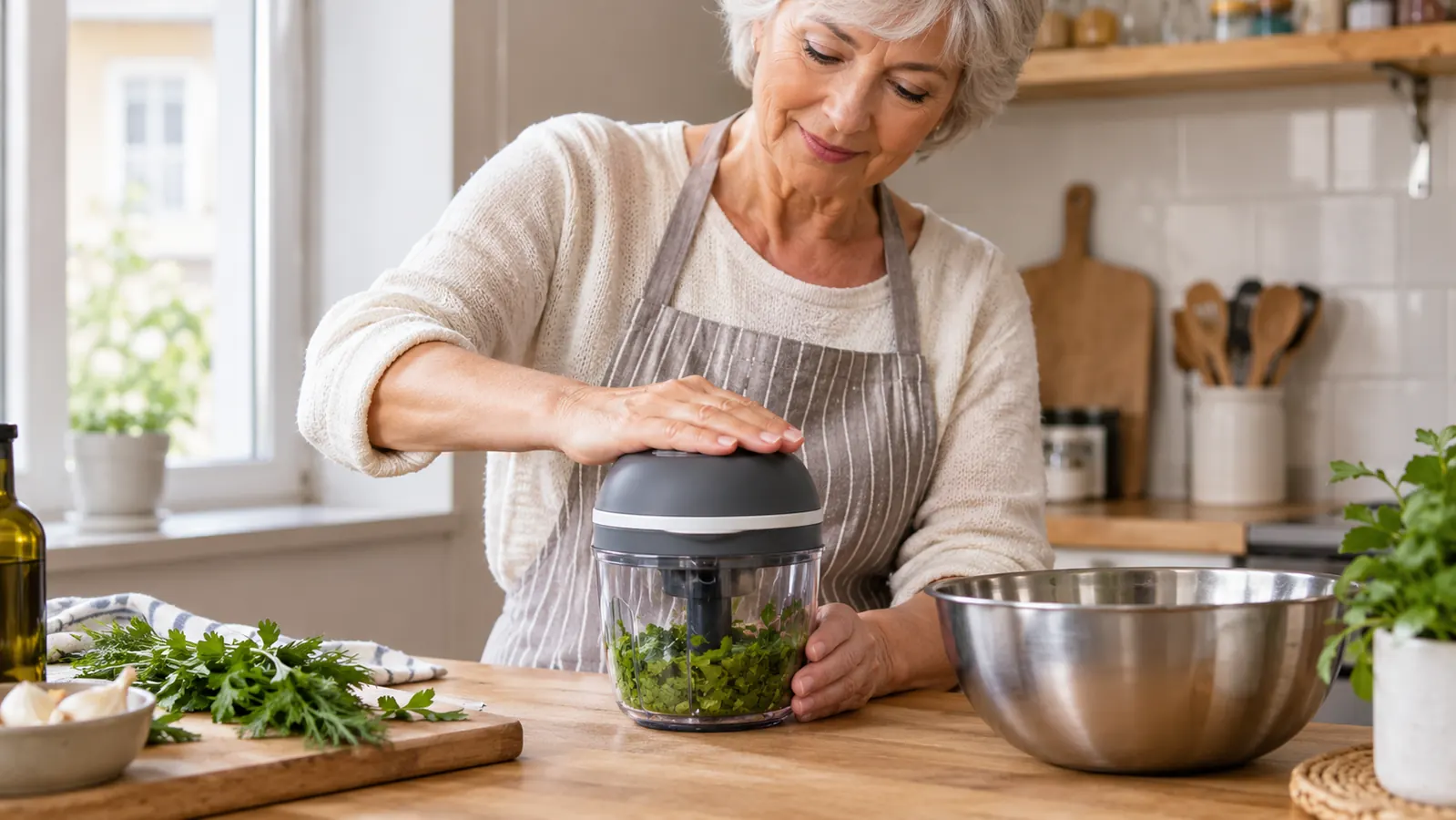
Here is what the product page does not tell you. The lid is the personality of this machine, and you have to learn it. It twists on with two tabs, and it has to be lined up exactly, or the machine will not run. That sounds like a small thing, but at seven in the morning, with an onion in one hand and a cup of coffee in the other, it is exactly the kind of small thing that can make you say words you do not use in front of grandchildren. The good news is that it becomes automatic after about a week. The honest news is that it is never quite as smooth as you want it to be, and every once in a while you will twist it, get nothing, and have to start over.
The button sits on top of the lid, so you press the whole lid down to run it. That means it is not hands-free. You hold the lid with one hand and let it work in five or ten second bursts. I came to like this, because it gives you a pulse control that a switch on the base never gives you. A few quick presses for a coarse chop, one longer press for something finer. But if you expected to load it and walk away, this is not that machine. You are part of the process every time.
The cord is another thing nobody mentions. It is short, about two feet, which is fine in my kitchen because the outlet strip is right there. If your only outlet is across the room, you will need an extension cord. There is also no cord wrap underneath, so you tuck the cord around the base and hope it stays. These are small things. But they are the small things that decide whether an appliance gets used or gets buried in a cabinet.
Where It Falls Short, and I Mean Really Short
Now for the part the five-star reviews skip. The bowl says 3 cups, and that is a generous way of measuring. The usable capacity, the amount you can actually load and get chopped, is closer to 1.5 cups. Fill it past that and the top pieces just spin around the blade, untouched, so you stop, shake the bowl, and go again. For me that is fine, because I am cooking for one. But if you are making a double batch of anything, you will do it in two rounds, and the second round will need the same attention as the first.
Hard foods are the second honest limitation. Carrots, raw sweet potato, and frozen ginger will test the motor. You have to cut them into small chunks first, and even then you want short pulses instead of holding the button down. If you let it run too long on something hard, you can hear the motor working, and you will learn to back off. The manual says to cut food into one-inch pieces, and it means it. This is not a machine that will power through a whole carrot on its own.
The third limitation is that it will not puree. It chops, and it minces, and it gets you close on soft things like avocado, but it is not a blender. If you want a smooth soup or a silky sauce, this is not the tool. I keep a small immersion blender for those jobs. They share a drawer and they do not fight.
One more honest note. The little rubber feet on the bottom do not grip as well as I would like on a smooth counter, so the whole base can wander a little when it runs on a hard surface. I set it on a folded dish towel now, and it stays put. Not a dealbreaker, but it is a real thing I did not read in any review before I bought mine.
The Cleaning Question Every Small Kitchen Cook Asks
Here is the question everyone asks when they see it on my counter: is it a pain to clean? The honest answer is no, with one caveat. The bowl, the lid, and the blade all go on the top rack of the dishwasher, and I have run them through dozens of times with no warping and no rust. But I usually wash them by hand, because it takes thirty seconds under the tap and I want the blade dry before it goes back in the bowl.
The caveat is the lid. The button mechanism has little gaps where onion juice and garlic oil collect, and if you do not rinse it right away, it gets sticky. I learned this the hard way after a pesto incident that required a soak. Now I rinse the lid immediately, every time, and it is a nonissue. The blade is genuinely sharp, which is good for chopping and bad for careless fingers. Wash it with the handle pointed away from you, and dry it before it goes in the drawer.
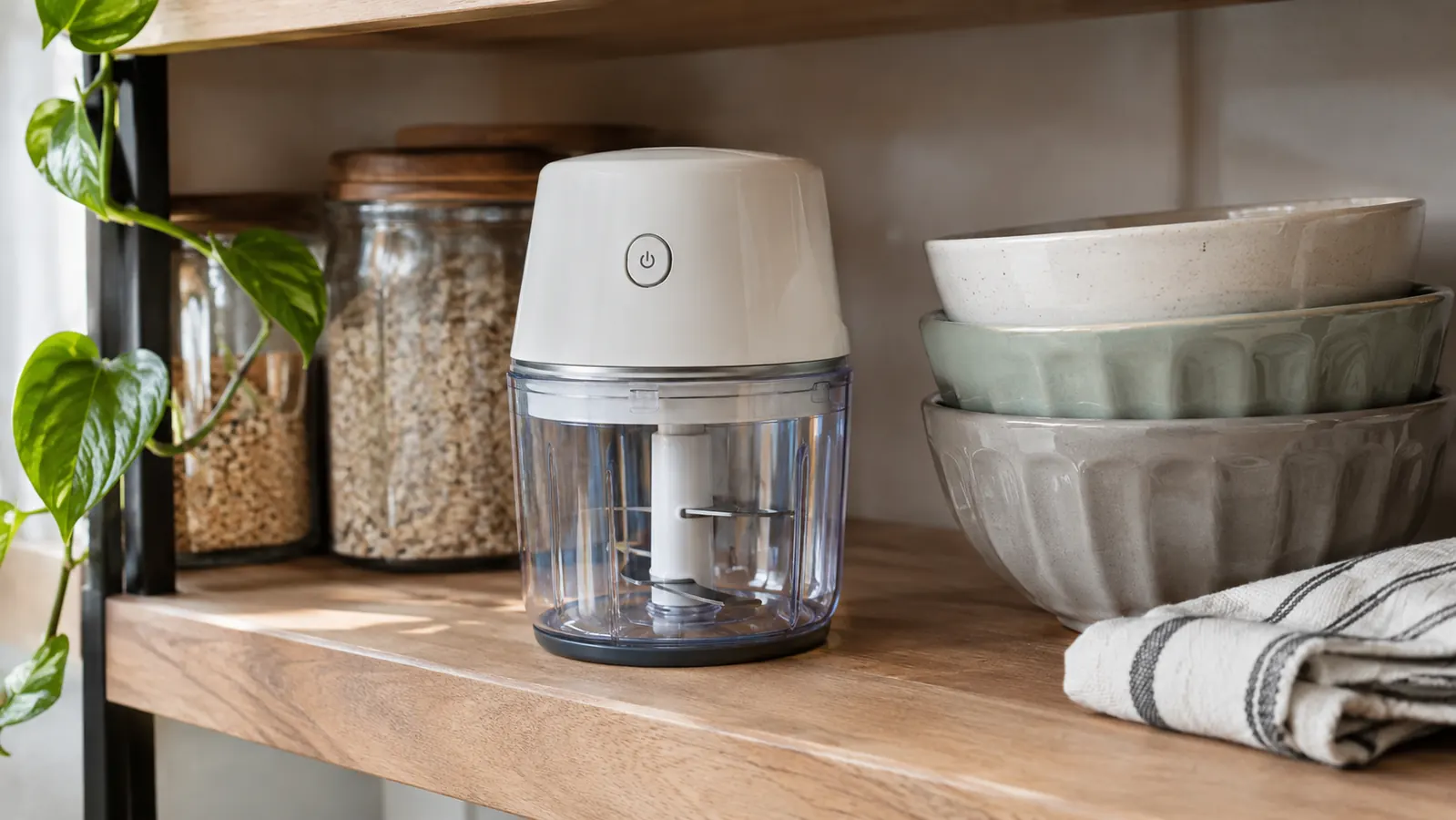
Storage is where this thing wins the whole argument for me. It is about six inches tall, and it sits in a corner of my counter that nothing else could use. I do not even put it away. It lives next to the toaster, under the cabinet, and it has never once been in my way. For a person with four feet of counter, that is the highest compliment I can give an appliance.
One more cleaning note. The base, the part with the motor, never goes near water. I wipe it with a damp cloth when crumbs gather under the bowl, and that is all it has needed in seven months. The bowl and the lid do all the hard work, and they are the parts that are easy to wash.
What I Gave Away vs. What I Kept
I did not buy this chopper without looking at the alternatives. The one I almost bought was the Cuisinart Mini Prep, which has a similar shape and a devoted following. I chose the Hamilton Beach for two reasons. The first is simplicity: this one has a single button on top, while the Mini Prep has a pair of buttons you have to press in a certain order, and I have reached an age where I want fewer steps, not more. The second is that the Hamilton Beach has a huge number of reviews from people who sound like me, regular cooks, not recipe developers.
I also thought about buying another full-size processor, because the old one had done good work for fifteen years. But I measured my counter, looked at the pantry cabinet, and admitted the truth. A machine I have to dig out of a cabinet is a machine I will not use. This one sits out, and I use it three or four times a week. That is the whole calculation, and it is a calculation about habits, not horsepower.
The grandkids have adopted it, too. They are old enough to press the button with supervision, and they think a machine that chops an onion in ten seconds is the most impressive thing in my kitchen. Honestly, it might be.
To be fair to the old machine, there are two jobs it did that this one cannot do. It sliced a whole head of cabbage for slaw in seconds, and it shredded a block of cheese without complaint. I still miss those two things on coleslaw and taco nights. For everything else I chop, the Hamilton Beach gets the call.
What I Liked
- Earns its spot: about six inches tall, and it lives out on the counter full time
- Pulse control on the lid gives real texture control, from coarse to fine
- Bowl, lid, and blade are dishwasher safe, and hand washing takes thirty seconds
- Handles onions, herbs, garlic, salsa, pesto, and breadcrumbs in seconds
- Simple enough to use without the manual, which is rare in small appliances
Where It Falls Short
- Usable capacity is closer to 1.5 cups than the 3 cups on the box
- The lid has to be lined up exactly or the machine will not run
- Not hands-free: you hold the lid button the whole time it runs
- Hard foods like carrots need small chunks and short pulses
- The rubber feet let the base wander on a smooth counter
Seven months in, I have used this chopper more than any other small appliance I kept, and I have never once missed the 14-cup processor I gave away.
Who This Is For
Buy this if you cook for one or two people and you chop things most days. Buy it if you are in a small kitchen, an apartment, a dorm room, a camper, or any place where counter space is measured in inches, because this earns its spot. Buy it if you are downsizing from a bigger kitchen and grieving the appliances you gave away, because this is the one that will make you feel better about the decision. And if you have been chopping onions by hand and crying into the cutting board, buy it for that reason alone.
It is also the right choice if you want a first food processor for a young cook, or if you want an appliance simple enough to use without reading the manual. There is exactly one button, the bowl empties easily, and the whole thing is small enough that it never feels like a commitment. It is the appliance equivalent of a friendly yes.
Who Should Skip It
Skip it if you cook for a family of four or more and you regularly chop two onions and three peppers at once, because you will be working in batches and the batches will test your patience. Skip it if you want to puree soup, make smooth sauces, or grind anything to a paste, because this chops and it does not puree. Skip it if you want a hands-free machine you can load and walk away from, because the button on the lid needs your hand on it the whole time.
And if you already own a full-size food processor that you actually use, you do not need this. It is not a replacement for that machine. It is a replacement for the hand-chopping you do when the big machine feels like too much work. If the big machine is already earning its cabinet space, let it keep working.
If You Cook for One or Two, This Earns Its Spot
Seven months of Tuesday-night onions and Sunday salsa say yes. See today's price on Amazon and decide for yourself.
Amazon Check Today's Price on Amazon →